
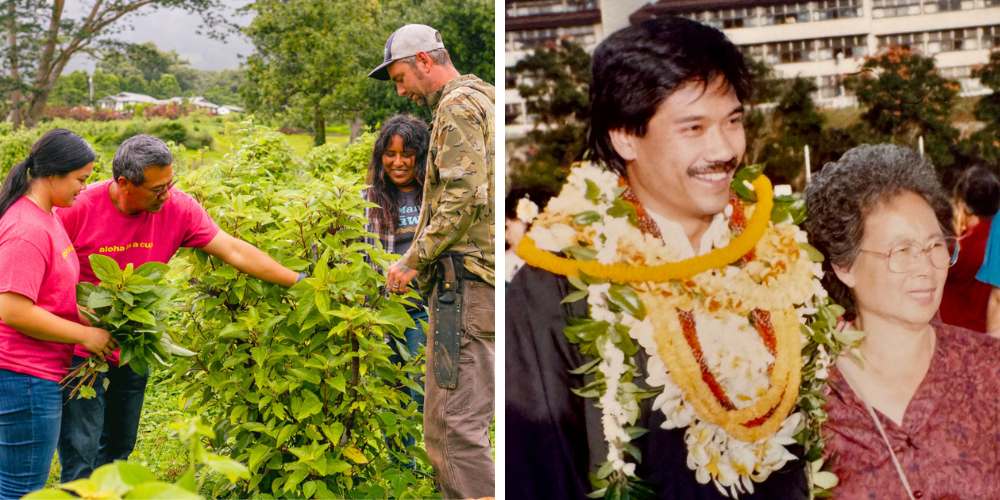
Q&A with Byron Goo | Founder of Tea Chest Hawaii
What did you study at UH, and what do you do now as the founder of Tea Chest Hawaii?
I studied Marketing and International Business while at UH. After graduating, I moved to Taipei to pursue a career in international business and learn Mandarin. I worked for the Hong Kong and Shanghai Banking Corporation, Hong Kong Bank, which also gave me the opportunity to work in Hong Kong. It was a dynamic time for both countries. I was one of only a couple of golfers in the company, so the CEO, a Scottish chap, took to me. He always reminded me that I spoke American, not English.
We just celebrated our 30th anniversary, so my roles have shifted over the years. My primary responsibility is business and product development. We’re involved in manufacturing, agriculture, hospitality, and tourism, so staying engaged in these industries keeps me busy.
What inspired you to start Tea Chest Hawaii?
As an American, I drank tea only at restaurants or when I got sick. My mom made us drink “leung cha” when we got sick which is a foul-tasting and terrible-smelling herbal tea. We had to drink a bowl of it, then sweat it out under the blankets. The saving grace was the rock candy we got to eat, which made the tea more palatable. It was nasty, but it worked every time.
I gained an appreciation for tea while living in Asia. Taiwan makes the best oolong in the world. There were tea shops all over the city. People drank it for refreshment and enjoyment. They socialized with tea. I was shocked to see tea selling for more than an ounce of gold.
The food scene in Hawaii was changing when I returned home. The Food Network made us curious about food. Celebrity chefs put a spotlight on cooking and Hawaii Regional Cuisine was becoming a movement. Starbucks opened its first location in Hawaii in 1995, so my thought was why not tea? I had lunch with Chuck Furuya, Hawaii’s first Grand Sommelier and one of only 13 in America at the time, and Stephanie Kendrick, food editor for the Honolulu Advertiser. We talked about food and beverage trends for 3 hours. One thing Chuck shared was that what happened to wine in the 70’s was happening to coffee in the 90’s, and trade journals were saying tea was going to be the third wave. It was a lunch that changed my life.
How did your UH experience influence your career or business journey? What’s one favorite memory from your time at UH?
I discovered that I like learning about different cultures and people while at UH. One of my favorite memories from UH was traveling abroad with the Pacific Asian Management Institute’s Summer Field Trip, led by Dr. K.K Seo. Dr Seo got us into the boardrooms of some major players such as Nissan (Japan), DaTung (Taiwan), and Hyundai (Korea). The discussions were lively because eMBA students and other professors were also in the group. That trip sparked my interest and gave me the courage to work overseas.
I’m currently the Chair of the Hawaii Pacific Export Council, a U.S. Commerce Secretary appointment. The Council helps businesses in Hawaii and Guam CNMI expand internationally. I’m still doing business in the countries we studied that summer back in 1986.
What makes tea special in Hawai‘i, and how does your company celebrate that?
Great question! Early in my career as a teamaker, my goal was to capture the flavors I grew up in our products. I wanted our mango tea to taste like the mangoes we picked from Aunty’s tree. I wanted our Passionfruit Iced Tea to have the same tangy-sweet finish as the vine-ripened lilikoi we ate while playing in Manoa Valley.
I’ve been fortunate to work with researchers from CTHAR and USDA to grow tea here. Some of the finest and rarest tea in the world now grows in Hawaii because of that investment.
The God thing is Hawaii has its own unique tea story. Tea is a delivery mechanism for wellness in many cultures worldwide. Tea is an easy and tasty way to enhance your quality of life, from plant-based nutrients like antioxidants to reduced inflammation and blood pressure, to mindfulness and relaxation. Traditional Hawaiian medicine is called la’au lapaau, which translates as “food as medicine.” Hawaii has it’s own native tea(not ti) plant called mamaki. Mamaki is an endemic plant that grows nowhere else in the world except in the Hawaiian rainforest, and it is used for healing in la’au lapaau. Mamaki tea is refreshing both hot and cold. The plant is rich in phytonutrients, including antioxidants, potassium, and rutin. Mamaki works as an adapotgen which helps the body achieve balance or homeostasis. For example, if blood pressure or cholesterol levels are elevated, mamaki can help lower them.
What does it mean to you to share your UH story during National Hot Tea Month?
My time at UH gave me a passion for learning new things and a curiosity about other cultures. For all the non-braniacs like me, there’s hope. Find your passion and pursue it.