
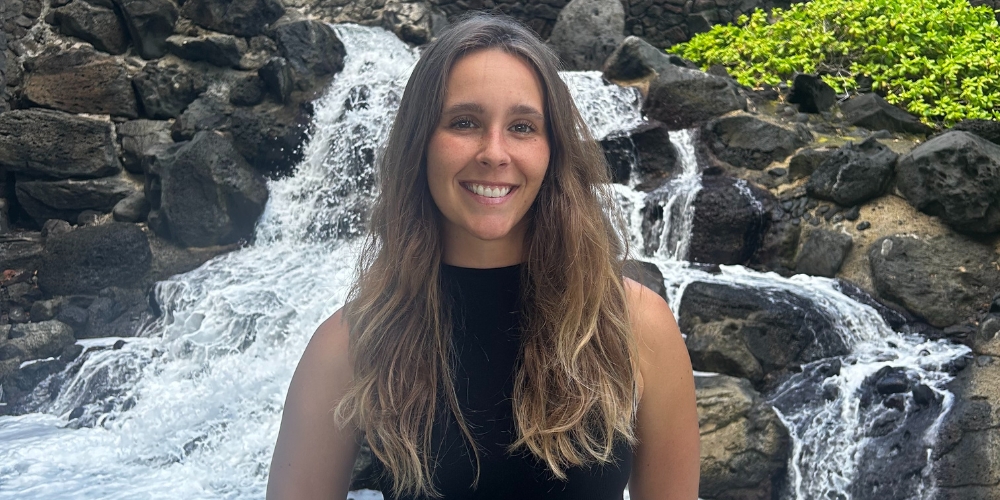
Meet Taylor Ledgerwood, Manager of the Kahala Initiative for Sustainability, Culture, and the Arts (KISCA)
What does your role as Manager of the Kahala Initiative for Sustainability, Culture, and the Arts entail? How has your work evolved from when you were Assistant Director of KISCA to your current position?
As Manager of the Kahala Initiative for Sustainability, Culture, and the Arts (KISCA), I focus on preserving and celebrating Hawai‘i’s unique cultural and natural heritage. A large part of my role is creating platforms—through events and guest activities—to showcase and celebrate our Hawaiian cultural practitioners, non-profit partners, local and Native artists, and restoration projects in the area. My work involves partnering with these stakeholders, organizing programs that connect both community members and guests to Hawaiian practices, and developing sustainability initiatives that protect our land and ocean. Whether it’s hosting tree-planting activities, coordinating cultural workshops, or collaborating on community projects, I aim to ensure that everything we do at KISCA supports regenerative tourism and honors our kuleana (responsibility) to care for our island home.
When I was Assistant Director of KISCA, my role centered around sustainability projects and environmental education programs. I led initiatives such as a live animal touch tank, coral education pop-ups, microplastic keiki art classes, and coordinated our Sunset Seminar speaker series. Additionally, I served as a liaison between the hotel and our non-profit partners and key community stakeholders, helping to strengthen those relationships. As Manager, my responsibilities have grown to include strategic planning, budgeting, and fostering closer partnerships with cultural practitioners and artists. By working more closely with them, I’ve been able to help create a better environment for their contributions at the hotel. One of the biggest shifts has been stepping into a role where I can shape the direction of KISCA’s programs and build on the foundation we’ve created. It’s been exciting and humbling to see how our work has evolved to make a bigger impact on our guests, team members, and the community.
What are some of the key projects you’ve led or been a part of through the Kahala Initiative for Sustainability, Culture, and the Arts?
As Manager of the Kahala Initiative for Sustainability, Culture, and the Arts (KISCA), I’ve been fortunate to work on some truly meaningful projects that combine sustainability, cultural preservation, and community connection.
A lot of what we do started with our partnership with the Coral Resilience Lab, which really set the foundation for many of the programs we still offer today. Through that partnership, we connected with Mālama Maunalua, and over the years, we’ve become an active part of their Restore with Resilience Project. It’s been so inspiring to see our role in this mauka-to-makai (mountain-to-sea) restoration effort grow. Strengthening relationships with nonprofits like this has been one of the most rewarding parts of my time with KISCA, and I’m so excited to see some of our future plans come to life.
One of my favorite projects was the Hanahou Mākeke, a marketplace that highlights local makers and designers. It’s such a fun way to support local hawaiian businesses while giving guests and the community a chance to experience live music, hula, and vintage Hawaiian lole (clothes) in a really vibrant setting.
We’ve also partnered with the Hawai‘i Music Perpetuation Society to expand our cultural programming. Together, we host monthly concerts featuring highly respected Hawaiian performers, along with workshops like lei-making and beginner Hawaiian language classes. These programs have been a great way to share the beauty of Hawaiian culture and traditions with both guests and locals.
On the sustainability side, I’ve worked on projects like tree-planting programs with Protect and Preserve. Guests can either sponsor a tree to be planted or join a volunteer day to plant it themselves. It’s such a powerful way for people to connect with the land and give back to the environment.
Another highlight has been hosting a surf film watch party to celebrate Hawai‘i’s surfing heritage. The event brought people together to enjoy films about the art and culture of surfing, sparking conversations about the ocean’s importance to Hawai‘i and to all of us.
We’ve also done seedball-making workshops with the Koʻolau Mountain Watershed Partnership, where guests get to help reforestation efforts while learning about the importance of protecting Hawai‘i’s watersheds.
These projects are all about building deeper connections with our land, culture, and with the amazing nonprofits we’ve partnered with. It’s been so cool to see these relationships grow over the years, and I can’t wait to see what’s next.
What achievements at in your career are you most proud of thus far?
One of the achievements I’m most proud of is how much the Kahala Initiative for Sustainability, Culture, and the Arts (KISCA) has grown during my time as manager. When I started in this role, I saw so much potential to build stronger partnerships with nonprofits and expand our cultural programs. Over the years, we’ve developed really meaningful relationships with organizations like Mālama Maunalua, Protect and Preserve, and the Hawai‘i Music Perpetuation Society. Together, we’ve created programs like tree-planting initiatives, monthly concerts with well-respected Hawaiian performers, and hands-on cultural workshops. Seeing guests and locals genuinely connect with the land and culture through these programs has been incredibly rewarding.
I’m also really proud of the role we’ve taken in the Restore with Resilience Project, which focuses on restoring ecosystems from the mountains to the sea. It’s been amazing to see our contributions to this effort grow over time and to know that we’re part of something that’s truly making a difference for Hawai‘i’s environment and communities.
Another highlight for me has been the chance to share our work beyond the hotel. Being invited back as a guest lecturer at the university is something I’m incredibly proud of—it’s so rewarding to speak with students about regenerative tourism and hopefully inspire them to think differently about the future of the hospitality industry. I’ve also had the chance to present at a handful of conferences on regenerative tourism, sharing the stage with industry leaders I’ve admired for years. Those moments have been such a privilege and a real career highlight for me.
And then there are the smaller but equally meaningful moments, like adjusting our programs to better meet guests’ needs or seeing local artisans thrive at events like Hanahou Mākeke. It’s those little wins that remind me why I love what I do and why I’m so passionate about this work.
Have there been any challenges you’ve had to overcome and if so, how did you approach them?
One of the biggest challenges I’ve faced is navigating my role as someone born and raised in Hawai‘i but not Hawaiian, and without a degree in Hawaiian Studies. I’m very aware of the responsibility that comes with representing and sharing Hawaiian culture, so I approach it with a lot of humility. I rely on cultural practitioners and local experts to guide our programs, making sure that what we offer is authentic and respectful. This collaboration is key to ensuring we’re honoring the culture in the right way.
In sustainability, there’s the ongoing challenge that a lot of impactful practices haven’t quite been embraced as “luxury” yet. It’s a balancing act to create exciting opportunities for guests like seedball-making or tree-planting while staying within the space of quiet luxury they expect. Guests come here to relax, so finding ways to present these programs as meaningful, memorable experiences that complement their stay has been a learning process. I’ve had to get creative, but it’s really rewarding when I see these programs resonate with people.
Another challenge has been communication. I often find myself code-switching between nonprofits, the hotel team, and the community. Each group has different expectations for professionalism and how we approach conversations. Nonprofits tend to prefer a more collaborative and informal style, while hotel environments often call for polished presentations and more structure. Learning to navigate those different styles to build the best relationships was definitely a learning curve, but it’s also helped me grow so much.
Advocating for new programs has also been a big part of my role, and it hasn’t always been easy. Pretty much every new project I’ve introduced has been met with at least some doubt. Whether it was concerns about logistics, guest interest, or resources, I’ve had to work through those negative voices to push things forward. It wasn’t always easy hearing that skepticism, but I stayed focused on the bigger picture and trusted the value of the work. So far, every program has ended up receiving positive feedback even from those who doubted it at first which always makes me feel like it was worth the effort.
These challenges have really shaped the way I approach my work. Whether it’s finding the right balance between sustainability and luxury, building relationships through communication, or advocating for something I believe in, I’ve learned that humility, persistence and flexibility go a long way. Seeing the positive impact of these programs on guests, the land, and the community makes it all worth it.
How do you see the role of sustainability and cultural initiatives evolving in Hawaii’s hospitality industry in the coming years?
I see sustainability and cultural initiatives continuing to evolve and becoming even more essential in Hawai‘i’s hospitality industry. What’s interesting, in my opinion, is that every property will likely develop its own unique “personality type” when it comes to regenerative tourism. Some will prioritize internal environmental initiatives like becoming LEED-certified, reducing waste, and cutting overall consumption. Others may focus more on social impact, emphasizing support for the community and Hawaiian cultural practitioners before aiming for things like carbon neutrality.
For example, Kyo-ya Hotels do a lot of charity work, supporting food drives, Make-A-Wish, and other social initiatives. On the other hand, properties like Twin Fin have focused on environmental partnerships, such as their collaboration with Parley for the Oceans. Both approaches are valuable, and I think this diversity will be a defining feature of the industry as it grows.
It won’t be a one-size-fits-all solution, and I think that’s a good thing. Each property will likely lean into its unique strengths and values to create offerings that resonate with their specific type of guest. That uniqueness will be a key part of what makes Hawai‘i’s hospitality industry stand out while allowing properties to support regenerative tourism in ways that are authentic to them.
At the same time, I think the industry as a whole will continue moving toward more meaningful connections with the environment, local communities, and cultural traditions. Regenerative tourism will play a big role in this, encouraging properties to not just minimize harm but actively improve the places and communities they operate in. For guests, it’s about more than just a vacation it’s about experiencing Hawai‘i in a way that’s respectful, impactful, and memorable.
Ultimately, I think the future of sustainability and cultural initiatives in hospitality will be about balance and intentionality. It’s exciting to imagine how each property will interpret and contribute to this movement in its own way, while still working toward a shared vision of supporting Hawai‘i’s land, people, and culture.
What advice would you give to current Shidler students who are interested in careers in hospitality or sustainability?
My advice to Shidler students interested in hospitality or sustainability is twofold, and it’s based on lessons I’ve learned throughout my own journey.
First, remember that we’re in the business of hospitality. It can feel intimidating to go to networking events or search for internships, but it’s important to appreciate that the core personality of our industry is to make people feel comfortable, welcomed, and valued. Leaders in this field are naturally hospitable, they want to help and connect. Don’t be afraid to introduce yourself, ask questions, and build relationships; most people are happy to share their knowledge and guide you.
Second, stay committed to your passion, even if it feels like the path isn’t fully clear yet. When I started college, I knew I wanted to go into sustainable tourism, but at the time, there weren’t a lot of jobs in that field. In fact, many people told me it wasn’t really a thing. But I didn’t let that stop me. I took classes in Hawaiian language, natural environmental resource management, and sustainability in Hawaii and I found ways to connect what I cared about into my course work for tourism classes. I even wrote my own job description to create the role I have now. Just because a class doesn’t exist for something doesn’t mean you can’t learn about it, and just because a job doesn’t exist doesn’t mean it never will.
Ultimately, don’t be afraid to carve your own path. Be patient, keep learning, and find ways to connect your interests with opportunities as they arise. Hospitality and sustainability are fields that are constantly growing and changing there’s room for innovation and for people like you to make a real impact.
Looking back, is there a particular lesson or experience from your time at Shidler or early in your career that has stayed with you?
One lesson that has stayed with me from my time at Shidler is the importance of showing up, even when you don’t feel ready. Early in my career, I remember being nervous about attending networking events or stepping into roles that felt outside my comfort zone. But each time I pushed myself to show up, I walked away with a new connection, opportunity, or lesson that helped me grow. It’s a reminder that you don’t have to have everything figured out to take the next step. Sometimes just being present is enough to move forward.
Another experience that’s stayed with me is learning how valuable mentorship and collaboration can be. At Shidler, I was lucky to have professors and peers who encouraged me to explore my passion for sustainability, even when the path wasn’t clear. Early on, I worked with people who trusted me to take on new challenges, and those experiences gave me the confidence to trust myself. That support, combined with a willingness to collaborate and learn from others, has been a guiding principle throughout my career.
Looking back, I’ve realized how much growth happens when you embrace the opportunities in front of you, even when they feel uncertain. Those moments, whether it was showing up to an event or working with someone who saw potential in me, shaped who I am today and taught me to always say yes to learning experiences.
Is there anything else you’d like to share that you think may be useful to the story?
I’d just like to emphasize how important it is to stay true to your passions and values, even if the path isn’t fully clear at first. My journey into sustainable tourism wasn’t a straight line. When I started, there weren’t many jobs in this field, and a lot of people didn’t think it was a viable career. But I stayed committed, found ways to weave my interests into the opportunities I had, and eventually created a role that aligns with what I care about most.
I also think it’s important to recognize the power of collaboration. None of the programs or projects I’ve worked on would be possible without the amazing partnerships we’ve built whether it’s with cultural practitioners, nonprofits, or my colleagues. It’s been inspiring to see how much can be accomplished when people come together with a shared vision for Hawai‘i’s future.
Lastly, I’d say that while it’s easy to focus on big milestones, some of the most meaningful parts of my work are the small, everyday moments like seeing a guest’s face light up when they learn something new about Hawaiian culture or watching a nonprofit’s mission gain momentum through our collaboration. Those moments remind me why I do what I do and keep me excited for what’s next.