
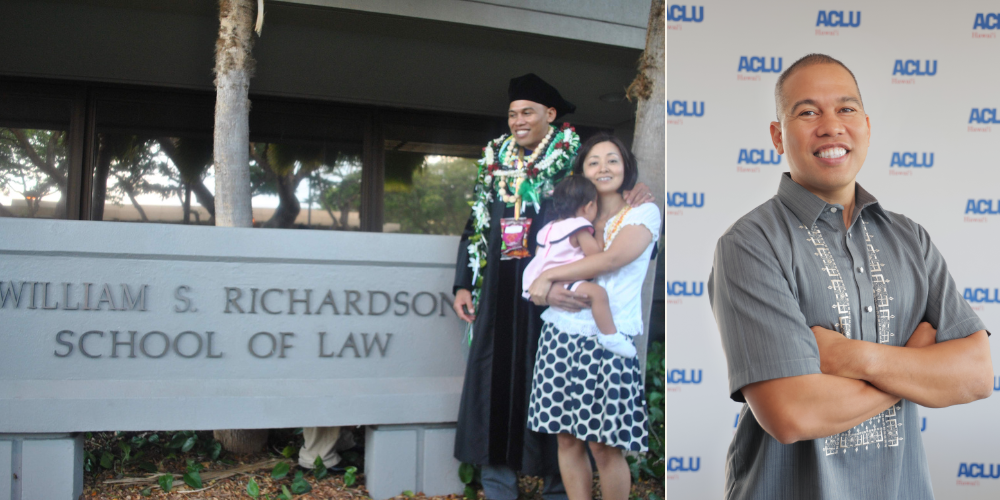
Meet Sergio Alcubilla, Director of Community Engagement at ACLU of Hawai‘i
Introduce yourself with your degree information and tell us what you do now.
Sergio Alcubilla, 2013 graduate of the William S. Richardson School of Law at the University of Hawai‘i at Mānoa. Director of Community Engagement for the American Civil Liberties Union of Hawai‘i (“ACLU-HI”).
You were recently named Director of Community Engagement. Tell us about this transition and what you’re most excited for in the new role.
As the Director of Community Engagement for the ACLU of Hawai‘i, I am excited to be able to draw from my experience in community organizing as the former Executive Director of the Hawai‘i Workers Center and in direct services as the Director of External Relations for the Legal Aid Society of Hawai‘i.
At the Hawai‘i Workers Center, I focused on empowering low-wage, non-union workers to organize for their own political, economic, and social well-being.
While at Legal Aid, I focused on expanding access to justice for our most vulnerable communities.
Both experiences showed me the importance of working in and with the community to help address the many issues we face here in Hawai‘i.
With so much happening politically and economically, not only across the country but right here in Hawai‘i, I get to draw on those past experiences in bringing the community into the important work of the ACLU to advance and defend our most basic rights. This is how I believe change can happen and this to me is exciting.
How does your current work reflect the kuleana you felt as a UH law student?
Professor Mari Matsuda, a nationally renowned law professor, asked our class, “What does it mean to be a Richardson lawyer?” That question left me with a sense that our law degree was meant for something more and as the only law school in Hawai‘i, we had a special responsibility to this land and her people.
As an immigrant to Hawai‘i, I am grateful that I can use the privilege of a legal education to empower others and help make our community better. When we seek to give back, to take on our kuleana, and to fulfill our shared responsibility; we begin to experience what makes Hawai‘i a special place.
What inspired you to pursue law, and why did you choose the William S. Richardson School of Law?
I don’t come from a family of lawyers, and it wasn’t until my community college professor recommended I go to law school that the thought ever crossed my mind. My life experiences of leaving the Philippines after witnessing the overthrow of the Marcos dictatorship, being raised in a working-class single-parent household, and growing up as a Filipino immigrant in the racially divided deep south would lead me in college to ask the question, “What’s wrong with this world and what can I do to help fix it?”
Looking for solutions, I decided to major in economics and political science thinking we could find answers there. After graduating, I decided to put off law school to work for various community based non-profit organizations while also earning a graduate degree from seminary school.
During this time, I learned so much of what it means to serve and work together with community that when it was time to look at law school again, I naturally gravitated towards public interest law.
When I had to make my decision between attending Richardson or a large law school on the continent; the values of what the law school stood for, its unique role in the Pacific and Asian regions, and the opportunity to make a difference for our large working class Filipino community here in Hawai‘i were what allowed me to make the right choice and attend Richardson.
What’s something you learned as a law student that still sticks with you today?
In our civil procedure class, Professor Eric Yamamoto taught us to analyze a legal decision, law, or policy by asking, “What’s really going on?” Throughout my experience working with the community, I’ve used this lesson to always think of the other factors that may be driving a decision, law, or policy. I’ve found it helpful when breaking down an issue, organizing others to support or oppose a bill, and to not take it personally when an issue is decided or voted on that’s opposite my position.
What is your favorite memory from your time at UH?
So many great memories but one my classmates and I still laugh at is the time our law school intramural basketball team surprisingly won the intramural basketball championship game by beating a much more athletic and younger undergraduate team.
Another is serving as President of our Filipino Law Students Association. We had such great synergy as an organization and developed long lasting friendships.
What advice would you give a current law student who is looking to make an impact in the community after graduation?
Whether you decide to go into private practice or the public sector, you will nevertheless make an impact here in Hawai‘i because you decided to stay and work here. By default, you will be involved and will make an impact. Whether or not it’s a positive or negative impact is entirely up to you.
This opportunity is what makes our legal community and Hawai‘i special. We are such a small community where our interconnectedness can be felt in so many ways. Do you simply take and extract as many others throughout Hawaii’s history have done or do you take on your kuleana and try to give back to this land and her people?
This shift in mindset will help guide you in how you decide to make an impact in the community and there are so many opportunities for Richardson graduates to do so. Find an area you’re interested in, connect with a mentor willing to pass on their knowledge to guide you, and pay it forward when your time comes.
Why do you think it’s important to stay connected to the UH alumni community?
Our legal community is a small one and your reputation is one that you carry with you throughout your career. Whether it’s walking on Bishop Street or visiting our neighbor islands, I cross paths with classmates and alumni all the time. The UH law school alumni network is incredible and if you’re looking to practice and work here in Hawai‘i it’s even more important to stay connected.