
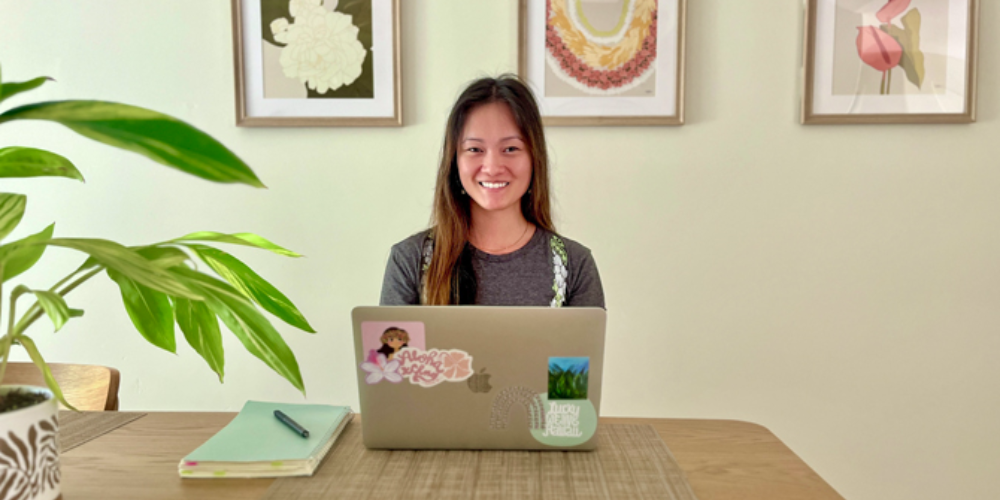
Meet Noelle Fujii-Oride, Editor at Overstory
Introduce yourself with your degree information and tell us what you do now.
Hi, I’m Noelle Fujii-Oride, and I graduated from UH Mānoa with a bachelor’s in journalism in 2016. I’m the editor of a new, online newsroom called Overstory.
What is Overstory? What inspired you to pursue a career in nonprofit journalism?
Overstory is a local, online newsroom dedicated to exploring the systems and solutions behind Hawai‘i’s most pressing issues. We apply a systemic, solutions-oriented lens to our in-depth reporting. We want to understand why things are the way they are and untangle the intersections between the patterns, systems and assumptions that shape Hawai‘i’s major challenges—and uncover potential ways forward. Much of our reporting follows a solutions journalism framework, which means we’ll rigorously investigate how communities are responding to challenges they’re encountering. We’ll look at the context surrounding a response, the evidence behind it, insights into how it works and its limitations. And, as a statewide newsroom, we embrace the fact that there’s a lot to be learned from all Hawai‘i’s communities, though we’ll especially be keeping an eye on the neighbor islands, which have seen decreased coverage of important issues over the years. Overstory launched in February 2025 and is an editorially independent program of local nonprofit The Kūpa‘a Network.
I love that nonprofit journalism emphasizes public service. It allows us to be intentional in our reporting. We spent months before our launch engaging community members statewide to get to know the communities we’ll be serving, build meaningful relationships, understand the issues and dynamics impacting them, and how they want to see local journalism be done differently. That process helped us select our initial coverage areas (housing, environment and health) and affirmed our approach to largely cover how communities are responding to Hawai‘i’s challenges (though we’ll also do other types of reporting, like explainers, investigations and resource guides). Community listening will continue to shape our reporting plans because we always want to make sure we’re serving our communities’ information needs and wants.
Can you tell us about a challenging investigative piece you've worked on and the impact it had on the community?
One of the most challenging investigative pieces I worked on was about private equity hotel ownership for Hawaii Business Magazine. This was a five-month project where I identified Hawai‘i’s hotel owners, how much of a presence private equity firms had in this industry, how that presence has changed over time, and what their impacts were on their employees and the surrounding communities. Digging through property tax records, Bureau of Conveyance records and other databases was a time-consuming process. One of my challenges was the layers of shell companies that sometimes mask full ownership.
This article was the first comprehensive piece about private equity’s ownership of Hawai‘i’s hotels. Community activists and others told me that the increasing presence of Wall Street investors in Hawai‘i is one example of how the hotel industry is increasingly being run by real estate corporations more interested in their bottom lines than in providing excellent guest service or in the long-term impacts on local communities. This article was and remains relevant as Hawai‘i residents experience frustration with the tourism industry’s impact on the environment and surrounding communities, and as Hawai‘i’s identity and culture continue to be threatened by outside interests and displacement of longtime residents.
What led you to choose UH Mānoa for your education?
I discovered my love for journalism while growing up in the Bay Area. I chose UH Mānoa because I wanted a college that had a solid journalism program and campus newspaper. I spent about four years working for UH Mānoa’s student paper, Ka Leo O Hawai‘i, as a reporter, then news editor and then editor-in-chief. Those years were foundational to my career as a journalist. I learned how to cover breaking news, investigate leads and manage a team.
What advice would you give UH students on successfully balancing academics with an internship?
I interned at Hawaii Business Magazine, the Honolulu Star-Advertiser and Honolulu Civil Beat during and after college. Internships played a large role in building my writing and reporting skills. It helped to block out time each week specifically for my internships. For example, during my spring 2014 internship at Hawaii Business Magazine, I saved part or all of Tuesday, Thursday and Friday afternoons for my magazine work. This helped me set boundaries between my school, Ka Leo and internship time. I also kept my editor updated on midterms and finals weeks, when I’d work fewer hours for the magazine.
What’s one unexpected lesson you learned since graduating?
Don’t be afraid to embrace your personal values, even in professional settings. Overstory, both as a newsroom and its journalism practice, is very much a blend of my personal values and traditional journalism standards of accuracy, fairness, integrity and transparency. Journalists are often told to distance themselves from the issues and people they cover, but we approach our work with the mindset that we are also part of the communities we serve and that our journalism is a way to show our care for this special place and its people. And we are forthright about this: Our journalism is in service of a more equitable and restorative Hawai‘i. We envision a Hawai‘i where Native Hawaiians and kama‘āina can afford to stay and thrive here; ‘Ōlelo Hawai‘i and Hawaiian culture are flourishing; Hawai‘i’s land, water and air are healthy and have meaningful, reciprocal relationships with the people who call these islands home; Native Hawaiian stewardship practices are abundant; and all residents have equitable access to privileges and opportunities.
What does being part of the UH alumni community mean to you?
I’m a proud UH Mānoa alumna and I’m grateful to be part of the alumni community. I’ve made so many professional connections because of UH and Ka Leo. Many of my friends from the student paper continue to work in journalism and/or in Hawai‘i, and I still keep in touch with them to talk about our field, get support and encourage one another. It means so much to see one another succeed and do what we can to encourage the next generation of journalists.
To read more on Noelle, click here.