
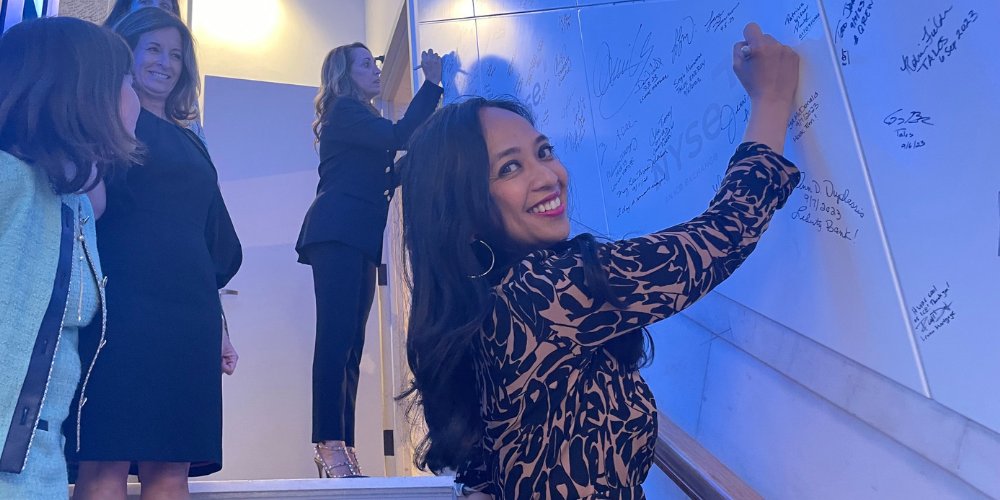
Meet Jennifer Ablan, Editor in Chief, Hawaii Business Magazine
Introduce yourself with your degree information and tell us what you do now.
Hi everyone! I’m Jennifer Ablan and I am a proud graduate of the University of Hawaii at Manoa with a bachelor’s degree in journalism and a minor in political science.
As Editor in Chief at Hawaii Business Magazine, what is your vision for its growth in the future?
My vision for Hawaii Business Magazine is to expand its reach beyond the islands and establish it as a nationally recognized publication. As the oldest regional business magazine in the country, it already has the credibility and foundation. Hawaii generates stories with national and even global relevance—from pioneering renewable energy policies (it was the first state to mandate 100% renewable energy by 2045) to leading climate adaptation efforts (such as the new tourist climate tax expected to raise $100 million annually). Issues like overtourism, once viewed as uniquely Hawaiian, are now shared by destinations across Europe and beyond. These are not just Hawaii stories—they’re America’s stories, too.
How does it feel to reconnect with the local community after years of living on the mainland?
I’ve spent most of my career in New York City, so connecting with Hawaii’s business community has been both surreal and refreshing. There are truly world-class leaders here. The drive and competitiveness are just as strong as what I saw in New York—but what really stands out is how mission-driven so many people are. There’s a genuine focus on community, culture, and making an impact beyond just the bottom line. It’s a different energy than what I experienced on Wall Street—less of the “What have you done for me lately?” attitude and more about lasting value.
Looking back on your 28-year career in business journalism, what pivotal moments have most influenced your leadership style?
I once had an influential editor, Martin Howell, tell me that if you’re in charge of a newsroom or a large team of journalists, you have to truly care about them. You can’t produce your best work alone. I’ve taken that advice to heart and firmly believe that managers need to support their journalists—always.
As a student at Radford High School, how did you choose UH Mānoa?
My parents encouraged me to attend the University of Hawai‘i, where many of my family members had earned their degrees. At the time, UH had a strong journalism program. I’ve shared this story before because it feels truly full circle—and a little bit magical. I took classes with Professor Ann Auman and worked hard to put my best stories in front of her. She eventually recommended me to her husband, who was then an editor at the Honolulu Star-Bulletin. He gave me my first opportunity in a real newsroom. That changed the trajectory of my career. Here’s where the story comes full circle: that editor was Steve Petranik, who would later become editor-in-chief of Hawai‘i Business Magazine in 2009. Today, I have the privilege of succeeding Steve following his retirement.
You served as editor of Ka Leo O Hawaiʻi, how did these experiences shape your approach to journalism today?
If you’re serious about becoming a reporter, editor, or photo/data journalist, it’s the best experience you can have before entering the real world. You learn how to report, write, and meet deadlines. I couldn’t believe we were paid a stipend to do what we loved.
Tell us about a professor or mentor at UH who made an impact on your professional journey?
Professor Ann Auman, obviously.
What advice would you give aspiring journalists from Hawaiʻi who want to make their mark in the industry?
You have to do what you love. I moved to New York because I wanted to be a business and finance journalist. I ended up there longer than originally planned because I married a New Yorker.
Why do you think it’s important to stay connected to the UH Alumni network?
The UH alumni network holds incredible power to create opportunities for people in mid- and late-stage careers. It’s also an important resource for the children of alumni and beyond. By coming together and investing in the next generation, we can shape a brighter future. Each of us has a vital role to play in ensuring the success not only of the next generation but also of our beloved university. Together, we can make a lasting impact.