
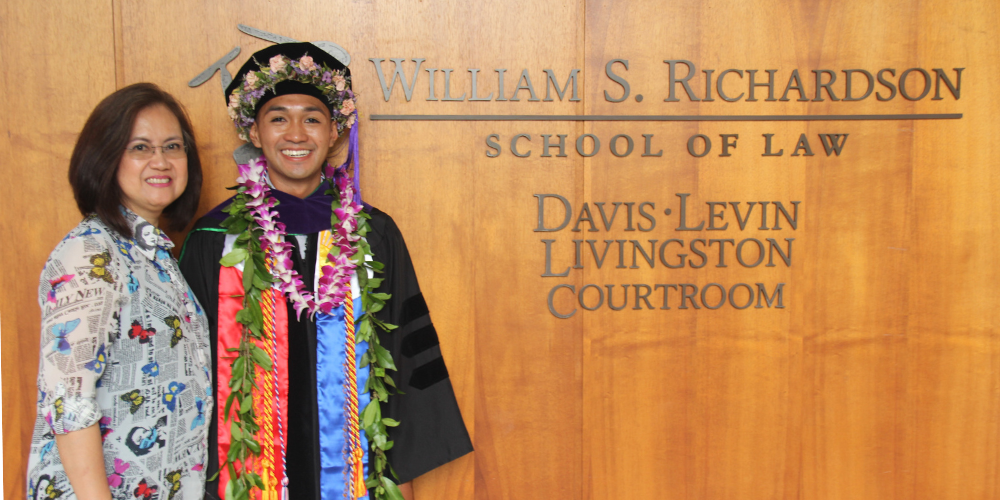
Meet Danicole Ramos, Equal Justice Works Fellow & Immigrant Veterans Advocate at the Refugee and Immigration Law Clinic
Introduce yourself with your degree information and tell us what you do now.
I graduated from the William S. Richardson School of Law in 2023 with a Juris Doctor degree. Shortly after graduation, I was awarded an Equal Justice Works Fellowship, through which I provide compassionate legal services and advocacy for noncitizen veterans who served in the United States military. I assist veterans with the naturalization process and represent them in removal proceedings. I also collaborate with veteran organizations to ensure that noncitizen veterans are informed about the immigration benefits to which they are entitled.
What inspired you to continue your work with the Refugee & Immigration Law Clinic after graduating from UH?
I have worked with Esther Yoo, Director of the Refugee and Immigration Law Clinic, for many years. I was her summer clerk as a 1L when she was an attorney at the Legal Clinic, and I later took her Immigration Clinic course during my 3L year of law school. Esther’s experience and expertise in immigration law have provided the mentorship I needed as a new attorney to make my fellowship a success.
The Refugee and Immigration Law Clinic gives law students the opportunity to work on real immigration cases involving real clients. Under the supervision of the clinic’s director, students represent clients before administrative agencies such as U.S. Citizenship and Immigration Services, the Executive Office for Immigration Review, and the Board of Immigration Appeals. The clinic plays a vital role in expanding access to legal counsel for Hawai‘i’s immigrant community.
By working at the clinic, I believe the fellowship can create a sustainable model that engages law students in a unique area of immigration law. It offers them the opportunity to gain hands-on experience and build essential skills to support noncitizen veterans, whether they choose to pursue immigration law professionally or assist on a pro bono basis in the future.
How did you come across Sae Joon Park’s case, and what made you decide to take it on?
It was the middle of March. I had just gotten off work and rushed to the North Shore to catch some fun 2–3+ foot waves with offshore winds at Haleiwa Ali‘i Beach Park. I was riding my favorite 9’6” Chronic longboard, trying to squeeze in a session before the sun set.
There’s an unko I’ve known for years who also surfs that spot, Tom. Unko Tom and I always chat when we’re out in the water. Most of the time, our conversations revolve around the surf conditions. But this time, he had a more serious question for me. He mentioned seeing on my social media that I was now an attorney and asked what kind of law I practiced. When I told him immigration law, he brought up a friend named Sae who might need my help. He said Sae was a veteran, had been shot, and that “the Feds want to deport him.”
It was such a random moment, but on the surface, it seemed to align perfectly with the mission of my fellowship—a veteran facing an immigration issue. After I got out of the water, I texted Unko Tom my business card, and the next day, Sae reached out to set up a meeting.
We spoke for two and a half hours. After hearing his story as a Purple Heart veteran, I found it incredibly compelling. From that point on, I knew I wanted to take his case.
In what ways did your experience at the William S. Richardson School of Law shape your approach to social justice and advocacy?
As a former student in the Refugee & Immigration Law Clinic working on an asylum case, I came to understand that achieving social justice requires empathy at the individual level.
Through that experience, I realized that it takes time for clients to share their full stories; especially when those stories are marked by trauma. Building trust is essential, and that requires patience, compassion, and consistency. Once trust is established, you’re able to advocate more effectively by helping shape a narrative that not only communicates the legal facts but also reflects the client’s hopes, dreams, and needs.
What’s a favorite memory or moment from your time at UH Mānoa that still sticks with you today?
Some of my closest friends graduated with me from Richardson, but I didn’t have the chance to truly connect with them until our 3L year, when pandemic restrictions were lifted and we returned to in-person classes. That’s when I met two classmates who, like me, were surfers.
During winter break, I took them to a secret surf spot, and it turned out to be an epic day. The waves were glassy, head-high, and the winds were offshore—we were scoring waves nonstop. That session gave us the time and space to really get to know each other. Since then, we’ve become regular surf buddies, paddling out together in the mornings before heading to work.
What advice would you give a first-year law student at UH?
I advise current and future law students to remember this: ‘Progress not perfection.’ Legal culture can sometimes feel designed to put more emphasis on perfection. My experiences have shown me that striving for progress each day is the better approach.”
How has staying connected to UH and its community supported you post-graduation?
The UH community, especially the Richardson alumni network, is tight-knit and incredibly supportive. Since Sae Joon’s case was shared in the media, many alumni have reached out to offer their support. They’ve helped by signing and sharing his petition, amplifying his story with elected officials to push for legislative action, and connecting me with more experienced attorneys to strengthen his case. I’m deeply grateful for their support, which truly reflects the collaborative spirit of the UH community.