
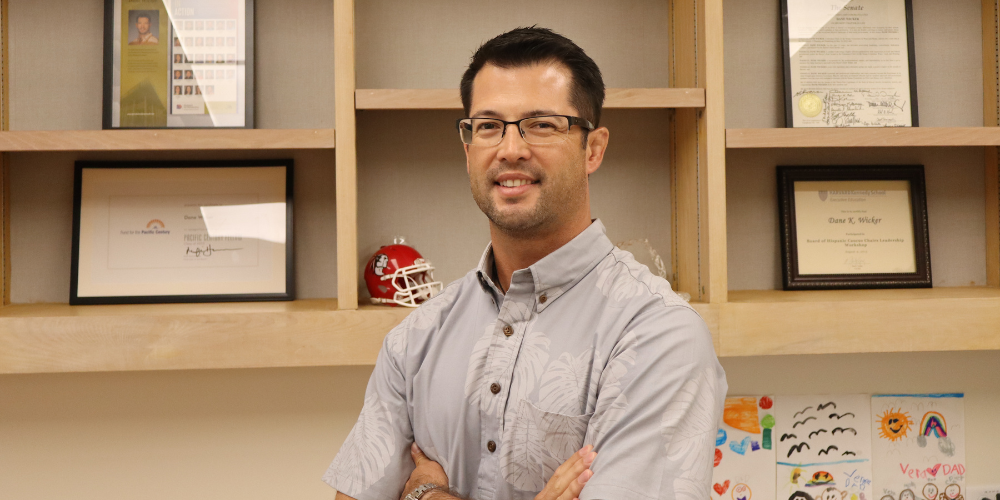
Meet Dane Wicker, Deputy Director of the Hawai’i Department of Business, Economic Development and Tourism (DBEDT)
Introduce yourself with your degree information and tell us what you do now.
I hold a Bachelor of Arts degree from the University of Hawaiʻi – West Oʻahu. For the past two years, I have served as the Deputy Director of the Department of Business, Economic Development and Tourism (DBEDT), where I help lead statewide initiatives to diversify and strengthen Hawaiʻi’s economy. Prior to that, I spent 11 years working at the State Capitol as Chief of Staff to a State Senator, helping to shape policy and budget priorities across a range of sectors.
As Deputy Director of DBEDT, what are some of the opportunities you see for Hawai‘i’s future?
DBEDT’s Economic Landscape strategy outlines a clear vision for diversifying our economy while building local capacity across sectors. Some of the most promising opportunities include investing in food systems, creative industries, clean energy, and tech and innovation. These efforts not only create jobs but help us increase exports, build up local manufacturing, and strengthen food and energy security. Critical to this is the State’s investment in infrastructure, workforce development, and aligning our education pipeline—from K-12 through higher education—to meet evolving industry needs.
Tell us about your transition from working in Washington, D.C., to returning to the State Capitol. What have you learned from serving in both environments?
Before working at the Capitol, I interned and worked at the Honolulu City Council, and later served on The Hill in Washington, D.C. That progression—from local to federal to state—gave me an in-depth understanding of what each level of government is responsible for. Local government handles community services like waste, roads, and zoning; the state oversees areas like education, healthcare, and infrastructure; and the federal government sets national policy and funding priorities. Returning to the State Capitol, I’ve been able to bring that perspective to help bridge local needs with state and federal resources.
You are also a co-owner of Kilani Brew, a small local tea business. What has that experience been like, and what have you learned about running a business in Hawai‘i?
Farming is my most recent venture, but prior to that, I owned and operated a small retail business. These experiences taught me firsthand how government regulations, access to capital, and infrastructure challenges directly impact small businesses. Being on the private sector side gave me a deeper appreciation for the importance of clear and supportive policies. It also drives the work I do in government—to reduce barriers and help more local businesses succeed.
How did you choose UH West O‘ahu to pursue your Bachelor of Arts degree?
I began my post-secondary education at Leeward Community College. At the time, UH West Oʻahu offered courses on the same campus, which was especially convenient as I was living on the North Shore. The location made it accessible, and the program offerings aligned with my interests. The smaller campus setting also made it easier to meet people, build meaningful relationships, and engage with instructors in a way that really shaped my academic experience.
What’s your favorite memory from your time as a student at UH?
One of my favorite memories was the ability to connect directly with faculty and fellow students. The campus environment was close-knit, which fostered open dialogue, collaboration, and a sense of community that made learning more impactful. Those relationships—both professional and personal—have had a lasting influence on my journey.
What advice would you give to current UH West O‘ahu students who want to serve their community through a career in politics?
Politics is one of many pathways to shape the future of our state for the next generation. My advice is to stay engaged, start building your network early, and seek opportunities—whether through internships or volunteer work—that give you a real-world understanding of how policy decisions are made. Choosing to pursue your education at UH West Oʻahu is already an investment in your future, and public service is an extension of that investment—one rooted in a commitment to community.
Why do you think it’s important to stay connected to the UH alumni ‘ohana?
Staying connected to the UH alumni ‘ohana keeps you rooted in your community and opens doors for mentorship, collaboration, and continued learning. It’s also a way to give back—whether by sharing your experiences, supporting current students, or helping to shape the next chapter of UH West Oʻahu’s impact across the state.