
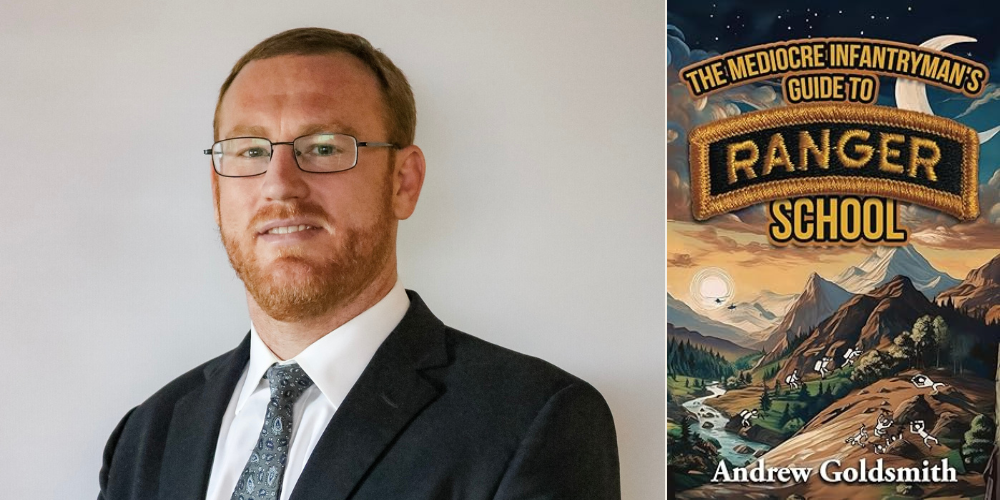
Meet Andrew Goldsmith, author of ‘The Mediocre Infantryman’s Guide to Ranger School’
Introduce yourself with your degree information, and tell us about your journey through the University of Hawai’i at Mānoa.
My name is Andrew Goldsmith and I graduated with a Bachelor’s Degree in Philosophy in the Fall of 2011. I attended UH Manoa in 2009 immediately after exiting the U.S. Army infantry and having served two years in Iraq. I took a few general education classes before studying abroad in Sevilla, Spain for a semester, which is where I decided to major in philosophy for the rest of my undergraduate studies.
What inspired you to pursue a degree in philosophy at UH Mānoa after your military service?
I first visited the UH Manoa campus in 2008 while on mid-tour leave from my second deployment to Iraq. After seeing the campus, I fell in love with the idea of going to school at UH Manoa, immediately applied, and received my acceptance letter in Baghdad, Iraq a few weeks later. I studied philosophy specifically because it appealed to my interests and greatly aided my transition from soldier to civilian, which can be difficult for many veterans. For some ancient Greek philosophers, the primary purpose of philosophy was to heal oneself, to use it as a form of therapy even. I utilized my philosophy studies for that purpose: to read heavy books, clarify my thoughts, and readjust to a different kind of life, with a different tempo and purpose, than the military which I was so used to.
If you could spend one day back on campus, what would you do?
I would walk every inch of campus, enjoying the trees, the gardens, all the lush greenery that I remember. I would also visit the philosophy department and chat with any professors I still knew from so long ago. Finally, I would sit in on an Eastern philosophy or history lecture and, if it was a hot day, grab a Jamba Juice smoothie as soon as class was over.
How did your time at UH help with your transition from military to civilian life?
In a lot of ways, my experience at UH Manoa was the polar opposite of my Army experience in Iraq. My time in Hawaii helped to balance me as an individual, tempered some of my military “edge,” and gave me the time and inspiration to write my first book, ‘Zarqawi’s Ice Cream,’ a memoir of my military experiences, which allowed me to process and make sense of my military service so that I could move on with my life. Through study, jiu jitsu, surfing, and positive interactions with my fellow students, many of whom were younger than me, I became “normal” again, a well-functioning civilian, one with a plan, goals, and new stories to write.
Can you explain your new book The Mediocre Infantryman’s Guide to Ranger School and how it came about?
Oddly enough, the most challenging, transformative experience of my military career was not either of my two deployments to Iraq, but the roughly eighty days I spent at the infamous U.S. Army Ranger School, widely considered one of the most difficult military training courses in the world. As I chronicle in my new book ‘The Mediocre Infantryman’s Guide to Ranger School,’ due to a lucky break, I arrived at the course unexpectedly and woefully unprepared, faced daunting challenges that nearly broke me and drove me to quit, and yet, given a purpose and against all the odds, I was able to survive the course and earn the coveted Ranger tab. I felt compelled to share my incredible and unlikely firsthand journey through the course, the characters I encountered, and the lessons that I learned, because they have been so impactful on my subsequent life development and perspective.
What do you hope readers take away from your book?
First, I hope they are truly entertained and informed about the unique, fascinating, and utterly crazy world that is U.S. Army Ranger School. But more than that, I hope they finish the story knowing that all of us, no matter how “mediocre,” are capable of more than we ever thought possible, that our true limits are far beyond what we think they are, and that anyone, with the right mindset and purpose, can conquer the seemingly insurmountable challenges that life will inevitably throw at us. Not all of us have the privilege (or is it misfortune?) to attend U.S. Army Ranger School but all of us will have our own personal “ranger schools,” whether that is divorce, the death of a parent or child, financial problems, illness, addiction, or being the victim of a crime. I hope that the lessons and perspectives in this book will be useful for helping the reader persevere through their own life ordeals.
What’s next for you - any future writing projects or personal goals?
I have several history-related books I would like to write at some point, but for now, I am going to spend the next few years focused on family, career, and jiu jitsu practice. It took over twelve years to get ‘The Mediocre Infantryman’s Guide to Ranger School,’ out into the world, so my writing hand could use a little rest.
To learn more and purchase a copy, click here.